

Stay Updated With Our Latest Insights
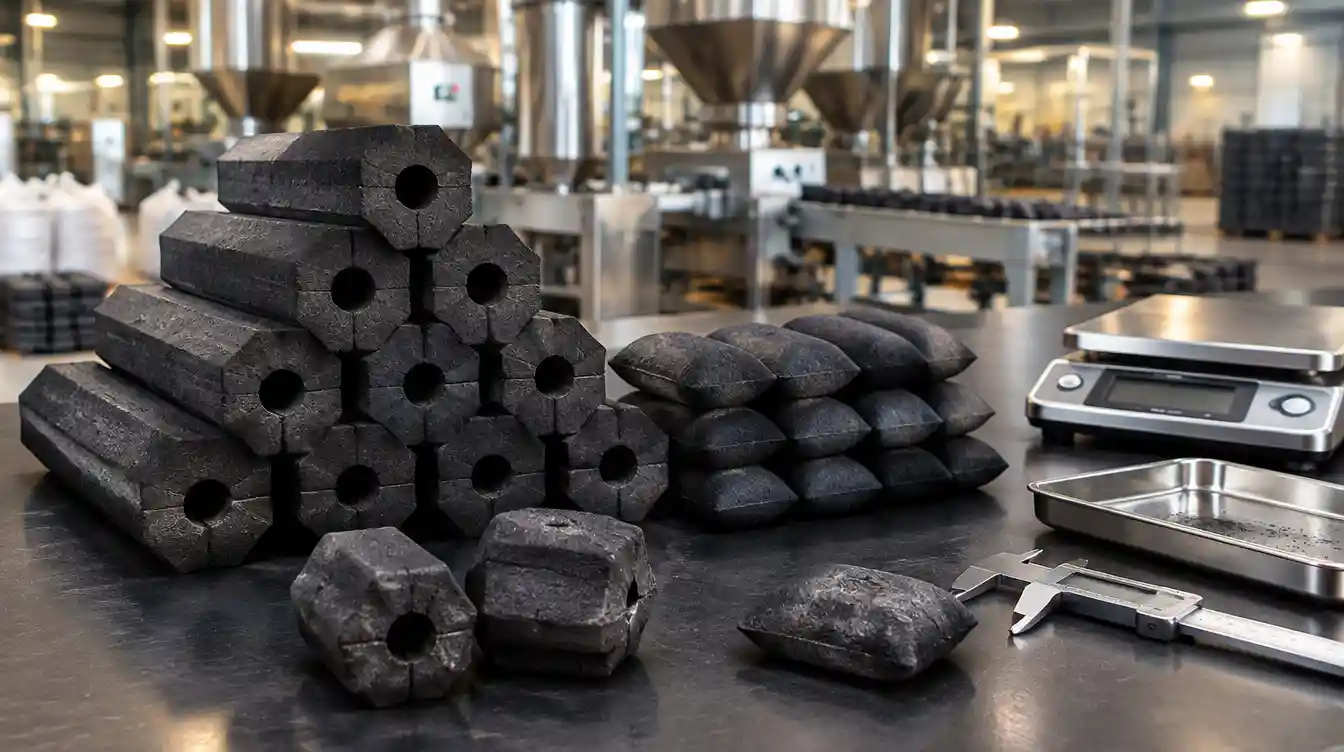
Industrial briquettes are fuel products that consist of solid materials that can be burned, formed under compression. They can be used with compatible industrial heating units including boilers and furnace installations. However, there can be significant differences between the quality and therefore performance of various varieties of briquettes. Raw material selection, moisture content, ash content, calorific value, density and other qualities affect how evenly the fuel burns and how easy it is to handle and store these products. Selecting quality, consistent fuel helps industrial buyers optimise processes, keep track of consumption and reduce cleaning with the following key indicators of quality.
Ideal industrial briquettes should have a uniform composition, the proper heating value, lower moisture and ash and sufficient mechanical strength. The high-quality briquettes of the final product is also dependent on the raw material and the manufacturing method. These factors can all influence the briquette quality of the final product so you should take all these factors into account when looking for a match.
Raw material has a significant influence on performance. The char of Coconut shell briquettes has a high carbon content and is one of the materials in some of the briquettes. The properties of this material depend heavily on the carbonisation process and the quality of the raw material that was used. Fixed carbon in briquettes is the amount of residual carbon that remains in the solid form after the volatile matter has been removed using standard test procedures. The ideal range of fixed carbon is designed to provide a sufficient level of carbon to support combustion, and a standard briquette has a set point. When considering a standard data sheet, be sure to also check for volatile matter and ash content, and calorific value. The more consistent the raw material the more consistent you can expect the fuel to be.
Moisture and ash content are critical measures of the quality of the briquette. Too much water adds to the heating load, perhaps reducing the overall effective heating capacity. It could also affect the way the briquettes are stored and combusted. Ash is the material left after combustion that does not burn. High-ash content will create more management, cleaning and maintenance of the remains, but low ash briquettes content is generally better. It can be beneficial if residue management is a concern, but acceptable ash content will depend on the application. Buyers should seek to have ash and moisture content in briquettes measured by testing, not just appearance.
The gross calorific value is the amount of heat generated when a given quantity of fuel is burned under a specified set of test conditions. Buyers of high-calorific briquettes or charcoal for industrial heating often compare calorific values when selecting a product, but it's only part of the story, and even then a high value on paper doesn't mean the system will generate that heat in practice. Combustion efficiency, ventilation, fuel feed and temperature all influence the amount of usable heat, so it is worth making sure all products are comparing 'like with like'.
Both density and strength are factors in briquette storage, handling and feeding. In some use situations, high-density briquettes occasionally offer a higher strength for handling, and a longer duration of burning depending on shape and air flow, as well as the material used. Crumbling or falling apart briquettes produce dust, pose handling problems and lead to irregular fuel feeds. Uniform size makes for more predictable combustion in systems optimized for a particular fuel size. Contract buyers should check for cracked or loose briquettes, excessive breakage and that the size and briquette durability is compatible with their feed equipment and storage needs.
The shape of a briquette influences its flow-ability, surface area and its burn characteristics. There are different briquette types here are two of them:
These shapes may interact differently when burning, depending on their dimensions and shape. The extra air flow through a hole in the middle of a briquette would generally be beneficial, depending on the fuel being burnt and conditions of use. No shape is automatically better – your choice should be influenced by the flow characteristics needed for the feeding system and by reliable manufacturers like Credent Exports advice, plus testing for consistent burning qualities.
Industrial fuel briquettes are compatible with other types of furnaces, boilers and thermal processing systems. They are compatible with other types of furnace depending on the fuel type, temperature range, combustion design and emission regulations. Here are some of the common briquette applications which include:
Prior to buying industrial fuel briquettes, check the availability of equipment, ventilation provision and rules pertaining to emission control. One use of a briquette may not be effective in another use.
The briquette quality testing so that the buyer may be sure that the product would fulfill their needs. Checking of the product as per the set procedures can identify differences prior to ordering. Consider these checks:
If the supplier is confident of their briquettes they should be able to provide briquette specification details and test reports. When comparing, buyers should look at how the testing was done, sampling method and report basis.
In the industrial purchase, there is also the need to verify that the product has the desired technical characteristics, and that the volume can be delivered steadily. Before placing an order, check the following:
| Credent Exports able to deliver a selection of commercial or industrial briquettes to local and industrial customers. Buyers should always request up-to-date specifications and test results prior to ordering. |
The best is made from right raw material, moisture & ash controlled, assured calorific value, consistent sizing, and good durability. Test properties of briquettes through samples and test reports can be checked by the industrial buyer before order if large quantity order.
| You can contact credible company Credent Exports when selecting high-quality briquettes for your enterprise and ask the sales team for details. |
The calorific value of good quality briquettes should be reasonable, and the moisture and ash contents should be within the permissible limits. They should have uniform composition, size and density, and be strong enough to handle.
Not always. Fixed carbon is relevant but calorific value, volatile matter, ash, moisture and combustion conditions also matter.
Too much moisture content is important in industrial briquettes to take up the heat required for evaporation and can also diminish the efficiency of the heating. It can also influence the storage and burning consistency.
There is no 'best' shape in all cases. The optimal shape is determined by the design of equipment, airflow, the type of fuel, and the wanted combustion characteristic.
Buyers can evaluate briquette quality by submitting samples - seek representative samples, test reports, product specifications and run trials to assess performance in service.
Buyers can contact Credent Exports to discuss bulk quantities, packaging, delivery schedules and product availability for their business needs.


